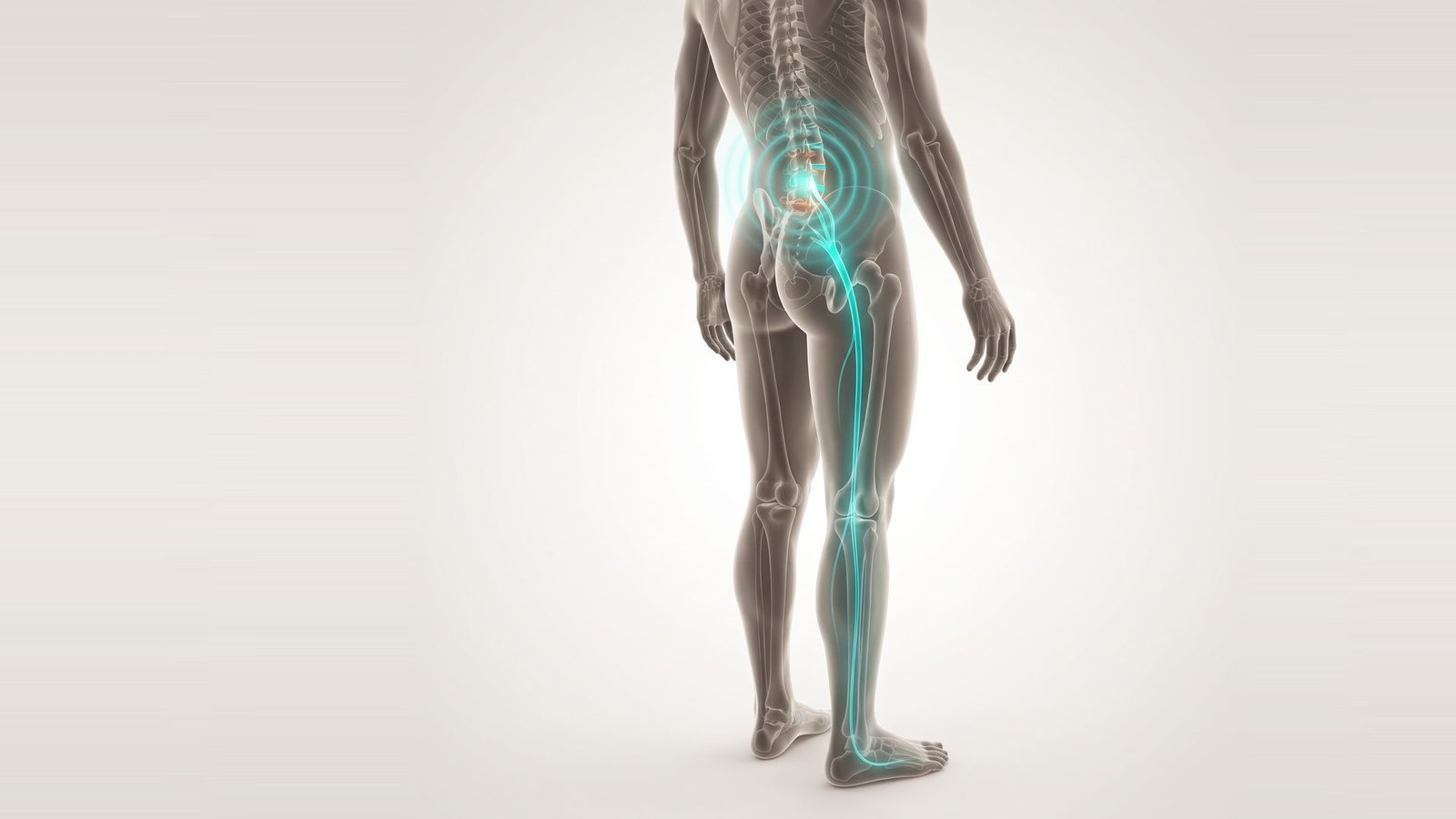
If you have felt a sharp, electric pain travel from your lower back through your buttock and down one leg, you are not dealing with an ordinary backache. That travelling pain is the signature of sciatica — and understanding what is actually producing it is the first step to making it stop.
What sciatica actually is
Sciatica is not a disease. It is a symptom.
The sciatic nerve is the largest nerve in the human body. It forms from nerve roots in the lower spine, passes through the buttock, and runs down the back of each leg to the foot. When something presses on or irritates that nerve where it exits the spine, you feel it along the nerve's whole path — as pain, burning, tingling, pins and needles, or numbness travelling down the leg.
This is the single most important thing to understand: the problem is at the spine; the pain shows up in the leg. That is why rubbing the calf, stretching the hamstring or massaging the leg never resolves it. You are treating the place where the alarm is ringing, not the place where the fire is.
Why the pain travels — and what its path tells us
Where the pain goes is diagnostic information, not just a description. Each nerve root supplies a defined territory, so the route your pain takes points to the level of the spine that is involved:
- Pain down the outside of the leg into the big toe commonly points to the L5 nerve root.
- Pain down the back of the leg into the sole or the outer toes commonly points to S1.
- Pain into the front of the thigh and inner shin more often points to L4.
This is why a proper sciatica assessment maps exactly where your pain travels, tests reflexes and muscle strength, and correlates that with imaging — rather than simply labelling everything "sciatica" and treating it identically.
What causes sciatica — and what makes it worse in Muscat
Most sciatica traces back to the lower spine. The common structural causes are:
- A herniated (slipped) disc pressing on a nerve root — the most frequent cause in adults under 50. If you have already been given this diagnosis, read what international guidelines actually recommend before disc surgery.
- Spinal stenosis — narrowing of the spinal canal or of the opening the nerve exits through, more common after 50.
- Degenerative disc change that reduces disc height and closes down the space available to the nerve.
- Spondylolisthesis — one vertebra sitting forward relative to the one below it.
- Postural and alignment loading — a flattened lumbar curve, a forward-shifted posture or a tilted pelvis that loads one side of a disc year after year until it fails.
- Piriformis syndrome, where the nerve is irritated by a deep buttock muscle rather than by the spine itself — a genuine mimic of sciatica, explained in detail in our article on piriformis syndrome.
Then there is lifestyle, which is where Muscat quietly stacks the odds:
- Long hours seated at a desk. Sitting raises pressure inside the lumbar discs well above standing, and most people sit in flexion, which loads the back of the disc — exactly where herniations occur. See how your office chair affects your spine.
- Driving across Muscat in traffic. Driving combines sustained flexion with vibration, and vibration is an independent risk factor for disc injury. A long commute is not neutral time for your spine.
- The summer. Months spent indoors and sedentary through the heat mean deconditioning at precisely the time the spine most needs movement — a pattern we see every year, and one we cover in why your spine suffers in the Gulf summer.
- Weak deep core support. The muscles that stabilise the lumbar spine switch off with prolonged sitting, transferring load from muscle to disc and joint.
None of these causes sciatica overnight. What they do is convert a minor, recoverable irritation into a recurring problem.
Sciatica, or something else?
Not every pain down the leg is sciatica, and the distinction changes the treatment completely:
- True sciatica — travels below the knee along a defined line, often with tingling or numbness, and is typically worse when sitting, coughing or sneezing.
- Referred back pain — aches into the buttock and upper thigh but stops above the knee, feels vague and diffuse rather than linear, and does not produce numbness.
- Hip joint pain — felt in the groin rather than the back of the leg, and worse on weight-bearing and rotation.
- Piriformis syndrome — deep buttock pain that appears mainly after prolonged sitting or driving, often without a clear lower back component.
A neurological examination separates these in minutes. Guessing between them can waste months.
The warning signs you should not ignore
See a professional promptly if you have:
- Pain that has lasted more than a week
- Pain that keeps returning after settling
- Weakness or numbness in the leg or foot — catching your toe on steps, or your foot slapping as you walk
- Pain that is worse at night or wakes you
- Sciatica that began after a fall or a road accident
Seek emergency medical care immediately — not an appointment next week — if you experience:
- Loss of bladder or bowel control
- Numbness around the groin, inner thighs or saddle area
- Sudden severe weakness in both legs
Those are the features of cauda equina syndrome. It is rare, but it is a surgical emergency and it is not a "wait and see" situation.
What helps at home — and what quietly makes it worse
Contrary to advice still given routinely, bed rest usually makes sciatica worse. Prolonged rest allows the supporting musculature to deconditions and the joints to stiffen, and the evidence has favoured staying gently active for years.
What genuinely helps:
- Gentle walking in short, frequent doses — yes, walking is generally good for sciatica, provided it does not sharply increase the pain below the knee
- Changing position every 30–40 minutes rather than sitting through the pain
- Supporting the lower back when seated so the natural inward curve is maintained
- Alternating sitting with standing across the working day
- Heat for muscular tightness and spasm
What quietly makes it worse:
- Aggressive hamstring stretching — this pulls directly on an already irritated nerve
- Deep, soft sofas and unsupported car seats, which push the lumbar spine into flexion
- Heavy or asymmetrical lifting during a flare
- Waiting it out on painkillers while continuing everything that caused it
On that last point: painkillers can quieten the pain, but they do not touch the cause. The pressure on the nerve is still there. Worse, masked pain removes the feedback that would otherwise stop you overloading the spine, which is one reason so many people find a manageable problem becomes a severe one.
How we treat sciatica — without surgery or long-term medication
At CBP Precision Spine Center — Oman's only Advanced Certified Chiropractic BioPhysics® practice — we do not guess. Every case begins with objective measurement:
- A full history and neurological examination — reflexes, muscle strength, sensation, and nerve tension testing — to establish which nerve root is involved
- Postural analysis to quantify how your spine is loaded in standing
- Digital spinal imaging to measure alignment against known normal values, rather than eyeballing it
- Correlation of all three, so the treatment addresses your actual mechanical fault and not a generic protocol
From there we build a correction plan, which typically combines:
- Chiropractic adjustment applied specifically in the direction opposite to your measured misalignment
- Spinal decompression and traction to reduce the mechanical pressure on the affected nerve root
- Targeted physiotherapy and rehabilitation to restore the stability that allows the correction to hold
- Posture rehabilitation aimed at the pattern that loaded the nerve in the first place
The goal is not to silence the symptom for a day. It is to correct the mechanics so the sciatica stops coming back. That is a different objective from pain relief, and it requires measurement to know whether it has actually been achieved. You can read the full detail of our sciatica and nerve pain treatment programme in Muscat, including what the first visit involves.
Which doctor should you see for sciatica or back pain?
For mechanical sciatica — the vast majority of cases — a chiropractor trained in measured spinal correction is a strong first stop, precisely because the problem is structural rather than systemic.
The equally important half of that answer: if your examination or imaging points to something that needs a surgeon, a rheumatologist or further medical investigation, a measurement-led assessment identifies it early. You find out in week one rather than after six months of treatment that was never going to work. We refer those cases on, and we would rather do that than treat something that is not ours to treat.
How long does recovery realistically take?
Honest expectations matter more than optimistic ones:
Weeks 1–2. Assessment, imaging review, and settling the acute nerve irritation. Most patients notice a change in pain intensity in this window, before any structural correction has happened.
Weeks 3–8. The active phase. This is when the majority of straightforward cases become substantially symptom-free.
Months 3–6. Correction and stabilisation — the phase that determines whether the sciatica returns. Treatment frequency falls; re-imaging where appropriate confirms whether alignment has actually changed.
Long-standing or repeatedly recurring sciatica takes longer than a first acute episode, because the underlying alignment has had years to establish itself. Anyone promising a fixed number of visits before examining you is guessing.
Frequently asked questions
Which doctor should I see for lower back pain in Muscat?
For mechanical back pain and sciatica — the large majority of cases — a chiropractor who works from objective spinal measurements is a strong first stop, because the cause is structural rather than systemic. A measurement-led assessment also identifies early the minority of cases that need a surgeon, rheumatologist or other specialist, and we refer those on rather than treating them.
Is walking good for lower back pain?
Usually, yes. Gentle walking in short, frequent doses beats bed rest for most lower back pain, because movement maintains circulation to the disc and stops the surrounding muscles stiffening. Start with 10–15 minutes and build up. Stop and reassess if walking sharply increases pain shooting below the knee.
How can I reduce back pain at home without medication?
Change position every 30–40 minutes rather than sitting through the pain, support your lower back when seated so the natural inward curve is maintained, alternate sitting with standing, walk in short doses, and use heat for muscular tightness. Avoid aggressive hamstring stretching and deep soft sofas. These measures manage the symptom; they do not correct the alignment causing it.
Is sciatica the same as a slipped disc?
No. A slipped or herniated disc is one possible cause; sciatica is the symptom it produces. A disc can herniate without ever causing leg pain, and sciatica can be caused by spinal stenosis, degenerative narrowing, spondylolisthesis or piriformis irritation instead. This is why imaging alone is not a diagnosis — the findings have to match your symptom pattern.
Why does sciatica keep coming back after it settles?
Because the episode was treated and the cause was not. Painkillers, rest and passive therapy can quiet an acute flare, but if the posture and spinal alignment loading the nerve are unchanged, the same nerve root is loaded again as soon as you return to normal activity. Correcting that alignment is what makes relief last.
How do I know whether my leg pain is sciatica or something else?
True sciatica usually travels below the knee along a defined line and often comes with tingling or numbness, and it is typically worse when sitting, coughing or sneezing. Pain that stays in the buttock and upper thigh is more often referred back pain; groin pain that worsens on weight-bearing points to the hip; deep buttock pain that appears mainly after long sitting can be piriformis syndrome. A neurological examination distinguishes them.
Living with sciatica or lower back pain in Muscat? Book a spinal assessment at CBP Precision Spine Center — 336 18th November Street, Azaiba. Call 7277 7796 or book your assessment online.
إن شعرتَ بألمٍ حادّ يشبه الصدمة الكهربائية ينتقل من أسفل ظهرك عبر الأرداف نزولاً إلى إحدى ساقيك، فأنت لا تتعامل مع ألم ظهرٍ عادي. هذا الألم المنتشر هو العلامة المميّزة لعرق النسا — وفهم ما يُنتجه فعلياً هو الخطوة الأولى لإيقافه.
ما هو عرق النسا فعلياً
عرق النسا ليس مرضاً. إنّه عَرَض.
العصب الوركي هو أكبر عصبٍ في جسم الإنسان. يتكوّن من جذورٍ عصبية في أسفل العمود الفقري، ويمرّ عبر الأرداف، وينزل خلف كلّ ساقٍ حتى القدم. وحين يضغط شيءٌ على هذا العصب أو يُهيّجه عند خروجه من العمود الفقري، تشعر به على طول مساره كلّه — ألماً أو حرقاناً أو وخزاً أو تنميلاً أو خَدَراً ينتشر نزولاً في الساق.
وهذه أهمّ نقطةٍ ينبغي فهمها: المشكلة في العمود الفقري؛ والألم يظهر في الساق. ولهذا فإنّ فرك الساق أو تدليكها أو تمديد أوتار الركبة لا يحلّ المشكلة أبداً. أنت تعالج المكان الذي يدقّ فيه جرس الإنذار، لا المكان الذي فيه الحريق.
لماذا ينتشر الألم — وما الذي يخبرنا به مساره
مسار الألم معلومةٌ تشخيصية، لا مجرّد وصف. فكلّ جذرٍ عصبي يغذّي منطقةً محدّدة، ولذلك يشير الطريق الذي يسلكه ألمك إلى مستوى العمود الفقري المتأثّر:
- الألم النازل على الجانب الخارجي للساق حتى إبهام القدم يشير عادةً إلى الجذر L5.
- الألم النازل خلف الساق حتى أخمص القدم أو الأصابع الخارجية يشير عادةً إلى S1.
- الألم في مقدمة الفخذ والساق من الداخل يشير غالباً إلى L4.
ولهذا فإنّ التقييم السليم لعرق النسا يرسم بدقّة أين ينتشر ألمك، ويفحص المنعكسات وقوّة العضلات، ويربط ذلك بالتصوير — بدل وصف كلّ شيء بأنّه "عرق النسا" ومعالجته بالطريقة نفسها.
أسباب عرق النسا — وما الذي يزيده سوءاً في مسقط
يعود معظم حالات عرق النسا إلى أسفل العمود الفقري. والأسباب البنيوية الشائعة هي:
- انزلاق غضروفي (ديسك) يضغط على جذر عصبي — وهو السبب الأكثر شيوعاً لدى البالغين دون الخمسين. إن كنت قد تلقّيت هذا التشخيص، اقرأ ما توصي به الإرشادات الدولية فعلياً قبل جراحة الديسك.
- تضيّق القناة الشوكية — ضيق القناة أو فتحة خروج العصب، وهو أكثر شيوعاً بعد سنّ الخمسين.
- التغيّرات التنكّسية في القرص التي تُقلّل ارتفاعه وتُضيّق المساحة المتاحة للعصب.
- انزلاق الفقار (Spondylolisthesis) — انزياح فقرة إلى الأمام بالنسبة للتي تحتها.
- التحميل الوضعي والاختلال في المحاذاة — انحناء قطني مُسطَّح، أو وضعية مائلة للأمام، أو حوض مائل يُحمِّل جانباً واحداً من القرص سنةً بعد سنة حتى ينهار.
- متلازمة العضلة الكمثرية، حيث يتهيّج العصب بفعل عضلةٍ عميقة في الأرداف لا بفعل العمود الفقري نفسه — وهي مُحاكٍ حقيقي لعرق النسا، نشرحه بالتفصيل في مقالنا عن متلازمة العضلة الكمثرية.
ثمّ يأتي نمط الحياة، وهنا تزيد مسقط الاحتمالات بهدوء:
- ساعات طويلة من الجلوس على المكتب. الجلوس يرفع الضغط داخل الأقراص القطنية إلى ما يفوق الوقوف بكثير، ومعظم الناس يجلسون منحنين، ما يُحمِّل الجزء الخلفي من القرص — وهو بالضبط موضع حدوث الانزلاق. راجع كيف يؤثّر كرسي مكتبك على عمودك الفقري.
- القيادة عبر ازدحام مسقط. تجمع القيادة بين الانحناء المستمرّ والاهتزاز، والاهتزاز عامل خطرٍ مستقلّ لإصابة القرص. فالتنقّل الطويل ليس وقتاً محايداً بالنسبة لعمودك الفقري.
- الصيف. أشهرٌ تُقضى في الداخل وبلا حركة بسبب الحرارة تعني تراجعاً في اللياقة في الوقت الذي يحتاج فيه العمود الفقري إلى الحركة أكثر من أيّ وقت — وهو نمطٌ نراه كلّ عام، ونتناوله في لماذا يعاني عمودك الفقري في حرّ الخليج.
- ضعف الدعم العميق للجذع. العضلات التي تُثبّت العمود الفقري القطني تتوقّف عن العمل مع الجلوس الطويل، فينتقل الحِمل من العضلة إلى القرص والمفصل.
لا شيء من هذا يُسبّب عرق النسا بين ليلةٍ وضحاها. ما تفعله هذه العوامل هو تحويل تهيّجٍ بسيطٍ قابلٍ للتعافي إلى مشكلةٍ متكرّرة.
عرق النسا أم شيء آخر؟
ليس كلّ ألمٍ ينزل إلى الساق عرقَ نسا، والتمييز يُغيّر العلاج تماماً:
- عرق النسا الحقيقي — ينتشر إلى ما تحت الركبة على خطٍّ محدّد، غالباً مع وخز أو خَدَر، ويزداد عادةً مع الجلوس أو السعال أو العطاس.
- ألم الظهر المُحال — يمتدّ إلى الأرداف وأعلى الفخذ لكنّه يتوقّف فوق الركبة، ويكون مبهماً منتشراً لا خطّياً، ولا يُسبّب خَدَراً.
- ألم مفصل الورك — يُشعَر به في المغبن لا خلف الساق، ويزداد مع تحميل الوزن والدوران.
- متلازمة العضلة الكمثرية — ألم عميق في الأرداف يظهر أساساً بعد الجلوس أو القيادة الطويلة، وغالباً دون مكوّنٍ واضح في أسفل الظهر.
الفحص العصبي يُفرّق بينها في دقائق. أمّا التخمين بينها فقد يُهدر أشهراً.
علامات الإنذار التي لا يجوز تجاهلها
راجِع مختصّاً دون تأخير إذا كان لديك:
- ألمٌ استمرّ أكثر من أسبوع
- ألمٌ يعود بعد أن يهدأ
- ضعفٌ أو خَدَر في الساق أو القدم — تعثّر أصابع قدمك في الدرج، أو ارتطام قدمك بالأرض أثناء المشي
- ألمٌ يزداد ليلاً أو يوقظك من النوم
- عرق نسا بدأ بعد سقوطٍ أو حادث سير
واطلب رعايةً طبيةً طارئة فوراً — لا موعداً الأسبوع القادم — إذا واجهت:
- فقدان السيطرة على المثانة أو الأمعاء
- خَدَراً حول المغبن أو باطن الفخذين أو منطقة السرج
- ضعفاً شديداً مفاجئاً في الساقين معاً
هذه سمات متلازمة ذيل الفرس. وهي نادرة، لكنّها حالة طارئة جراحية وليست ممّا "ننتظر ونرى" فيه.
ما الذي يُفيد في المنزل — وما الذي يزيد الأمر سوءاً بهدوء
خلافاً لنصيحةٍ ما زالت تُقال روتينياً، فإنّ الراحة في السرير تزيد عرق النسا سوءاً عادةً. فالراحة المطوّلة تُضعف العضلات الداعمة وتُيبّس المفاصل، والأدلّة تُرجّح البقاء نشطاً بلطف منذ سنوات.
ما يُفيد فعلاً:
- المشي الخفيف بجرعاتٍ قصيرة متكرّرة — نعم، المشي مفيدٌ عموماً لعرق النسا، شرط ألّا يزيد الألم أسفل الركبة بشكلٍ حادّ
- تغيير الوضعية كلّ 30–40 دقيقة بدل الجلوس رغم الألم
- دعم أسفل الظهر أثناء الجلوس للحفاظ على الانحناء الطبيعي للداخل
- المبادلة بين الجلوس والوقوف على مدار يوم العمل
- استخدام الحرارة للتيبّس والتشنّج العضلي
وما يزيد الأمر سوءاً بهدوء:
- التمدّد العنيف لأوتار الركبة — فهو يشدّ مباشرةً على عصبٍ مُتهيّج أصلاً
- الأرائك الغائرة ومقاعد السيارات غير المدعومة، التي تدفع العمود القطني إلى الانحناء
- الرفع الثقيل أو غير المتوازن أثناء النوبة
- الانتظار على المسكّنات مع الاستمرار في كلّ ما سبّب المشكلة
وبخصوص النقطة الأخيرة: المسكّنات تُهدّئ الألم، لكنّها لا تمسّ السبب. الضغط على العصب ما زال موجوداً. والأسوأ أنّ إخفاء الألم يُلغي التغذية الراجعة التي كانت ستمنعك من تحميل عمودك الفقري أكثر، وهذا أحد أسباب تحوّل مشكلةٍ قابلة للإدارة إلى مشكلةٍ شديدة لدى كثيرين.
كيف نُعالج عرق النسا — دون جراحة أو أدوية طويلة الأمد
في مركز CBP للدقة في العمود الفقري — العيادة الوحيدة في عُمان الحاصلة على الاعتماد المتقدّم في تقنية Chiropractic BioPhysics® — نحن لا نُخمّن. تبدأ كلّ حالةٍ بقياسٍ موضوعي:
- تاريخ مرضي كامل وفحص عصبي — المنعكسات وقوّة العضلات والإحساس واختبارات شدّ العصب — لتحديد الجذر العصبي المتأثّر
- تحليل الوضعية لقياس كيفية تحميل عمودك الفقري في وضع الوقوف
- تصوير رقمي للعمود الفقري لقياس المحاذاة مقابل القيم الطبيعية المعروفة، بدل تقديرها بالنظر
- ربط العناصر الثلاثة معاً، حتى يعالج البرنامج خللك الميكانيكي الفعلي لا بروتوكولاً عامّاً
ومن هناك نبني خطة تصحيحٍ تجمع عادةً بين:
- تعديل تقويم العمود الفقري المُطبَّق تحديداً في الاتجاه المعاكس لاختلال المحاذاة المقاس لديك
- التخفيف والشدّ الفقري لتقليل الضغط الميكانيكي على جذر العصب المتأثّر
- علاج طبيعي وإعادة تأهيل مُستهدَفة لاستعادة الاستقرار الذي يسمح للتصحيح بالثبات
- إعادة تأهيل الوضعية الموجَّهة إلى النمط الذي حمّل العصب في المقام الأول
الهدف ليس إسكات العَرَض ليومٍ واحد، بل تصحيح الميكانيكا حتى يتوقّف عرق النسا عن العودة. وهذا هدفٌ مختلف عن تسكين الألم، ويتطلّب القياس لمعرفة ما إذا كان قد تحقّق فعلاً. ويمكنك الاطّلاع على التفاصيل الكاملة لـبرنامج علاج عرق النسا وآلام الأعصاب في مسقط، بما في ذلك ما تتضمّنه الزيارة الأولى.
أيّ طبيبٍ ينبغي أن تراجع لعرق النسا أو ألم الظهر؟
بالنسبة لعرق النسا الميكانيكي — وهو الغالبية العظمى من الحالات — يُعدّ أخصائي تقويم العمود الفقري المُدرَّب على التصحيح المَقيس نقطةَ بدايةٍ قوية، وذلك تحديداً لأنّ المشكلة بنيوية لا جهازية.
والنصف الآخر من الإجابة لا يقلّ أهمية: إن أشار فحصك أو تصويرك إلى ما يحتاج إلى جرّاح أو أخصائي روماتيزم أو فحوصٍ طبية إضافية، فإنّ التقييم القائم على القياس يكشف ذلك مبكّراً. تعرف الأمر في الأسبوع الأول بدل ستّة أشهر من علاجٍ لم يكن لينجح أصلاً. ونحن نُحيل تلك الحالات، ونُفضّل ذلك على معالجة ما ليس من اختصاصنا.
كم يستغرق التعافي واقعياً؟
التوقّعات الصادقة أهمّ من المتفائلة:
الأسبوعان 1–2. التقييم ومراجعة التصوير وتهدئة التهيّج العصبي الحادّ. يلاحظ معظم المرضى تغيّراً في شدّة الألم في هذه المرحلة، قبل حدوث أيّ تصحيحٍ بنيوي.
الأسابيع 3–8. المرحلة النشطة. وفيها تتحرّر غالبية الحالات المباشرة من الأعراض إلى حدٍّ كبير.
الأشهر 3–6. التصحيح والتثبيت — وهي المرحلة التي تحدّد ما إذا كان عرق النسا سيعود. تنخفض وتيرة العلاج، وتُؤكّد إعادة التصوير عند الاقتضاء ما إذا كانت المحاذاة قد تغيّرت فعلاً.
عرق النسا المزمن أو المتكرّر يستغرق وقتاً أطول من النوبة الحادّة الأولى، لأنّ الاختلال الكامن كان لديه سنوات ليترسّخ. وكلّ من يَعِدُك بعددٍ محدّد من الجلسات قبل أن يفحصك إنّما يُخمّن.
الأسئلة الشائعة
ما الطبيب الذي ينبغي أن أراجعه لألم أسفل الظهر في مسقط؟
بالنسبة لألم الظهر الميكانيكي وعرق النسا — وهما الغالبية العظمى من الحالات — يُعدّ أخصائي تقويم العمود الفقري الذي يعمل انطلاقاً من قياساتٍ موضوعية للعمود الفقري نقطةَ بدايةٍ قوية، لأنّ السبب بنيويّ لا جهازيّ. كما أنّ التقييم القائم على القياس يكشف مبكّراً تلك الأقلية من الحالات التي تحتاج إلى جرّاح أو أخصائي روماتيزم أو تخصّصٍ آخر، ونحن نُحيلها بدل أن نعالجها.
هل المشي مفيد لألم أسفل الظهر؟
عادةً نعم. المشي الخفيف بجرعاتٍ قصيرة ومتكرّرة أفضل من الراحة في السرير لمعظم آلام أسفل الظهر، لأنّ الحركة تُحافظ على تروية القرص وتمنع تيبّس العضلات المحيطة. ابدأ بعشر إلى خمس عشرة دقيقة ثمّ زِد تدريجياً. توقّف وأعِد التقييم إذا زاد المشي الألمَ المنتشر أسفل الركبة بشكلٍ حادّ.
كيف أُخفّف ألم الظهر في المنزل دون أدوية؟
غيّر وضعيتك كلّ 30–40 دقيقة بدل الجلوس رغم الألم، وادعم أسفل ظهرك أثناء الجلوس للحفاظ على الانحناء الطبيعي للداخل، وبادِل بين الجلوس والوقوف، وامشِ بجرعاتٍ قصيرة، واستخدم الحرارة للتشنّج العضلي. تجنّب التمدّد العنيف لأوتار الركبة والأرائك الغائرة. هذه الإجراءات تُدير العَرَض، ولا تُصحّح الاختلال المُسبِّب له.
هل عرق النسا هو نفسه الانزلاق الغضروفي؟
لا. الانزلاق الغضروفي سببٌ محتمل واحد؛ أمّا عرق النسا فهو العَرَض الناتج عنه. يمكن أن ينزلق القرص دون أن يُسبّب ألماً في الساق إطلاقاً، وقد ينتج عرق النسا عن تضيّق القناة الشوكية أو التضيّق التنكّسي أو انزلاق الفقار أو تهيّج العضلة الكمثرية. لهذا فإنّ التصوير وحده ليس تشخيصاً — يجب أن تتطابق نتائجه مع نمط أعراضك.
لماذا يعود عرق النسا بعد أن يهدأ؟
لأنّ النوبة عُولجت والسببُ لم يُعالَج. المسكّنات والراحة والعلاج السلبي قد تُهدّئ النوبة الحادّة، لكن إن بقيت الوضعية ومحاذاة العمود الفقري المُحمِّلة للعصب دون تغيير، فإنّ جذر العصب نفسه يتحمّل الضغط مجدّداً فور عودتك إلى نشاطك المعتاد. تصحيح تلك المحاذاة هو ما يجعل الراحة تدوم.
كيف أعرف إن كان ألم ساقي عرق النسا أم شيئاً آخر؟
عرق النسا الحقيقي ينتشر عادةً إلى ما تحت الركبة على خطٍّ محدّد ويُصاحبه غالباً وخز أو خَدَر، ويزداد عادةً مع الجلوس أو السعال أو العطاس. أمّا الألم الذي يبقى في الأرداف وأعلى الفخذ فهو غالباً ألم ظهرٍ مُحال؛ وألم المغبن الذي يسوء مع تحميل الوزن يُشير إلى مفصل الورك؛ وألم الأرداف العميق الذي يظهر أساساً بعد الجلوس الطويل قد يكون متلازمة العضلة الكمثرية. الفحص العصبي هو ما يُفرّق بينها.
هل تعاني من عرق النسا أو ألم أسفل الظهر في مسقط؟ احجز تقييماً للعمود الفقري في مركز CBP للدقة في العمود الفقري — 336 شارع 18 نوفمبر، العذيبة. اتصل على 7277 7796 أو احجز تقييمك عبر الإنترنت.