


Office Back Pain in Muscat: Why Your Chair Is Quietly Damaging Your Spine — and What Actually Fixes It
Lower back pain from sitting at work? Discover why 60% of GCC office workers suffer — and how CBP precision care in Muscat delivers lasting relief.
Iyad Ali
5/5/20268 min read
The Most Common Pain in Muscat's Office Towers
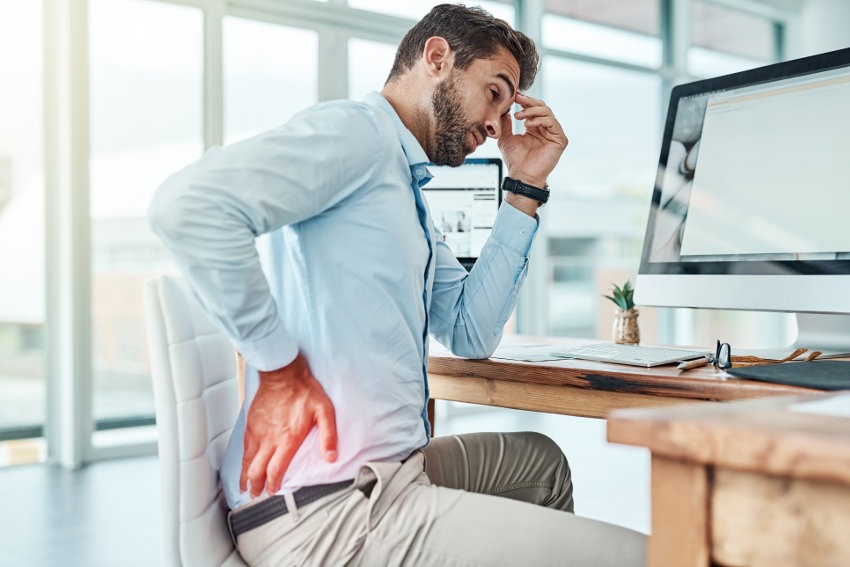
Walk through any office building in Al Khuwair, MQ, the CBD, or Knowledge Oasis Muscat at 4 PM and you'll see the same thing on dozens of faces: that small grimace as someone stands up from their desk, one hand instinctively pressed to the lower back. They roll their shoulders. Stretch. Sit back down. By tomorrow morning they'll do it all again.
It's so normalized in the GCC corporate world that we barely register it. But it shouldn't be normal — and the data backs that up.
A 2023 study of office workers in Saudi Arabia found that 59.9% experience work-related lower back pain. Another, larger study published the same year found that 84.5% of office workers reported musculoskeletal pain in the past year, with the lower back the most affected region (54.5%). These aren't fringe statistics. They describe the lived reality of nearly every desk worker in the Gulf.
If you're reading this from your office in Muscat — whether you work in oil and gas, banking, government, hospitality management, IT, or any other desk-bound profession — there's a six-in-ten chance your back hurts right now. And there's a very high chance that what you're doing about it isn't working.
This article explains why your chair is quietly damaging your spine, what most people get wrong about treating it, and what actually delivers lasting relief.
Why Sitting Is So Hard on Your Lower Back
Most people assume sitting is "resting." It isn't. From your spine's point of view, sitting is one of the most demanding positions you can put it in.
Here's what's actually happening when you sit at your desk for eight hours a day:
1. Disc pressure increases dramatically. Research has consistently shown that pressure on your lumbar discs is significantly higher when you're sitting than when you're standing — and even higher when you're sitting and slouching forward toward a screen. Over years, that elevated pressure accelerates disc wear and increases the risk of bulging or herniation.
2. Your hip flexors shorten. Sit for eight hours and your hip flexor muscles literally adapt to that shortened length. When you finally stand up, those tightened muscles pull on your pelvis and tilt it forward, which exaggerates the natural curve in your lower back and creates a constant, low-grade strain.
3. Your glutes switch off. Long periods of sitting cause your gluteal muscles — the most important muscles for supporting your lower back during movement — to become weak and inactive. Doctors call this "gluteal amnesia." When your glutes can't do their job, your lower back muscles take over, and they exhaust themselves trying.
4. Your core deactivates. Your deep stabilizing core muscles (the transverse abdominis, multifidus) only switch on when your spine is in proper alignment. Slouched in an office chair, those muscles go quiet. Without them, every movement you make is unsupported.
5. Postural collapse becomes structural. This is the most important point. After enough years, your spine doesn't just "hurt when you sit" — it physically remodels. The vertebrae shift. Curves flatten. Discs wedge. What started as discomfort becomes a permanent change in how your spine is shaped.
Why GCC Office Workers Are Especially Vulnerable
The pattern of lower back pain in the Gulf is not identical to what we see in Western office populations. Several factors specific to life in Muscat and the GCC make it worse:
Long working hours. A significant proportion of GCC office workers spend eight or more hours a day seated at a desk — often longer in oil and gas, finance, and government roles where extended hours are normalized.
Long commutes by car. Driving from Mawaleh, Al Mouj, or Bausher into central Muscat at peak hours can add another 60–90 minutes of seated time on each end of your day. Driving posture is even harder on your spine than office sitting because your arms are extended forward, often gripping the wheel tightly.
Climate-driven inactivity. For much of the year, outdoor walking and recreation in Oman are uncomfortable due to heat. This eliminates the natural movement that office workers in cooler climates get from walking commutes, lunchtime walks, and weekend activity outdoors.
High prevalence of related risk factors. The GCC has some of the highest rates of obesity, diabetes, and vitamin D deficiency in the world — all of which independently worsen lower back pain. The Saudi office worker study identified being overweight, sleep disturbance, history of back trauma, and frequent work stress as independent risk factors. Most GCC professionals carry at least one of these.
Cultural factors around seeking help. Only about 30% of office workers experiencing musculoskeletal pain in the regional studies sought medical advice. Most people simply live with it, hoping it improves on its own. It rarely does.
What Most People Try First — and Why It Doesn't Work
When lower back pain from sitting starts, most people in Muscat try the same sequence:
Stage 1: Painkillers. Paracetamol, ibuprofen, or stronger anti-inflammatories from the pharmacy. These mask pain by reducing inflammation. They do nothing to address why your spine is inflamed in the first place. The pain returns the moment the medication wears off — and long-term use carries real risks for your stomach, kidneys, and liver.
Stage 2: A "better" chair. Office workers often invest in expensive ergonomic chairs hoping the new chair will fix the problem. A good chair helps, but if your spine has already lost its proper curvature, no chair on Earth can sit you in a position your spine no longer holds naturally.
Stage 3: Stretching and YouTube exercises. Generic back exercises sometimes provide temporary relief, but they're often the wrong exercises for your specific spinal pattern. Stretches that help one person can actively worsen another person's condition.
Stage 4: Massage or generic physiotherapy. Massage feels good and reduces muscle tension temporarily. But if the underlying problem is structural — your spine is mechanically misaligned — soft tissue work alone cannot correct it.
Stage 5: Resignation. Most people eventually decide back pain is "just part of getting older" or "part of working a desk job." This is the most damaging stage of all, because untreated structural problems progressively worsen.
The pattern is consistent: people treat the symptom (pain) over and over, while the cause (a structural change in spinal alignment) continues to deteriorate.
The Difference Between Pain Relief and Spinal Correction
This is the single most important distinction in spinal healthcare, and it's the difference that defines our work at CBP Precision Spine Center.
Pain relief addresses how your back feels right now. Painkillers, massage, basic adjustments, and heat therapy all do this well. They are valid and useful — but they are not corrective.
Spinal correction addresses how your spine is shaped. Through precise diagnostic imaging, calibrated traction, mirror-image adjustments, and targeted corrective exercises, the goal is to physically restore your spine to its biomechanically ideal alignment — so that the underlying cause of your pain stops generating pain in the first place.
This is the foundational principle of Chiropractic BioPhysics® (CBP), the methodology our clinic specializes in. CBP is the most heavily researched chiropractic technique in the world, with over 200 peer-reviewed studies supporting its protocols. It is fundamentally different from traditional chiropractic, which focuses on short-term symptom relief through manual adjustments.
For office workers with chronic lower back pain, the difference matters enormously. After years of sitting, your spine is not in its original position. Adjustments and stretches alone cannot move it back. What works is a structured, measured, multi-month corrective program based on objective imaging — and that is what CBP provides.
What Treatment Actually Looks Like
When an office worker comes to our clinic in Azaiba with chronic lower back pain, the assessment and treatment process has a clear structure. We're transparent about it because there should be no surprises.
Step 1 — Comprehensive postural and structural assessment. This includes detailed history, postural analysis, and where indicated, digital X-ray imaging. We measure exactly how much your spine has shifted from its ideal alignment. Without this measurement, treatment is guesswork.
Step 2 — Personalized care plan. Based on the assessment, we build a plan that typically combines mirror-image adjustments, calibrated cervical and lumbar traction, and corrective exercises specific to your spinal pattern. Where appropriate, we may also incorporate Class 4 laser therapy for inflammation or extracorporeal shockwave therapy for chronic soft tissue issues.
Step 3 — Active correction phase. The first three to six months focus on actively correcting your spinal alignment. This is when most patients see their pain reduce significantly — but the goal is not just pain reduction. The goal is measurable structural change.
Step 4 — Stabilization and maintenance. Once corrections are achieved, the focus shifts to keeping them. This includes home exercises, ergonomic guidance for your specific workstation, and periodic check-ins.
Five Things You Can Do at Your Desk Starting Tomorrow
While structural correction requires professional care, there are five evidence-based habits that genuinely help — both as prevention and as support for ongoing treatment:
1. Stand up every 30 minutes. Set a timer if you have to. Just standing for 60 seconds resets disc pressure, reactivates your glutes, and breaks the postural collapse cycle. This single habit, done consistently, has more impact than any chair upgrade.
2. Adjust your monitor to eye level. If you're looking down at a laptop, you're forcing your neck and upper back into a position that cascades down into lower back strain. A laptop stand and external keyboard cost less than a single physiotherapy session.
3. Sit all the way back in your chair. The lumbar curve in a good office chair only works if your back is actually touching it. Most people sit forward, hunched toward the screen, with empty space behind their lower back.
4. Walk during phone calls. If your job involves frequent calls, take them standing or walking when possible. Even pacing around your office for 5 minutes per call adds up to significant movement over a workday.
5. Strengthen your glutes. Weak glutes are the single biggest hidden cause of office back pain. Even basic exercises like glute bridges, done daily for 5 minutes, can dramatically reduce the load on your lower back.
These habits are helpful — but they are not a substitute for treatment if you already have chronic pain. If your back has hurt for more than a few months, behavioral changes alone will not fix what has become a structural problem.
When Should You Actually See a Specialist?
Most office workers wait far too long. Here are the specific signs that mean you should book a consultation rather than continue managing it yourself:
Lower back pain that has lasted more than 6 weeks
Pain that radiates down one or both legs (this may be sciatica, which we treat extensively)
Numbness, tingling, or weakness in your legs or feet
Morning stiffness that takes more than 15 minutes to ease
Pain that wakes you up at night
Pain that is gradually getting worse despite rest, stretching, or pain medication
A noticeable change in your posture, gait, or ability to stand straight
Difficulty sitting through meetings, drives, or flights without pain
Any one of these warrants professional assessment. Two or more is a clear signal that what you have is structural, not muscular — and structural problems do not resolve themselves.
Why CBP Precision Spine Center
There are several clinics in Muscat that treat back pain. What distinguishes our approach:
We are the only certified Chiropractic BioPhysics® (CBP) clinic in Oman.
Dr. Richard Marchetti, DC has over 16 years of international experience and has been based in Muscat for more than a decade.
Our diagnostic process is objective and measurable. We don't guess at your spine's condition — we image it, measure it, and track measurable change over time.
We treat lower back pain as one component of your overall spinal posture, not as an isolated symptom.
Our care plans combine multiple evidence-based modalities (CBP adjustments, traction, laser, shockwave, corrective exercise, nutrition support) under one roof.
Take the First Step
If you've been managing office back pain for months or years — cycling through painkillers, chair upgrades, generic stretches, and resignation — there is a different path. One that addresses why your spine hurts, not just how it feels.
Lower back pain from sitting is not an inevitable cost of working a desk job. It is a structural problem with a structural solution. The earlier you address it, the easier and shorter the corrective process.
📍 Villa 336, 18 November Street, Azaiba, Muscat, Oman 📞 +968 7277 7796 ✉️ info@CBPSJ.com 🌐 www.cbpsj.com
Book your spinal assessment today — and find out exactly what's happening in your lower back, and what it will take to fix it for good.
CBP Precision Spine Center
Villa 336, 18th November St
Azaiba, Muscat
Oman, 130
Quick Links
Subscribe To Our News Letter!
info@CBPSJ.com
+968 7277 7796
© 2024. All rights reserved.