

Scoliosis in Oman: Your Complete Guide to Diagnosis, Treatment, and ScoliBrace®
Comprehensive scoliosis guide for Oman families. Non-surgical care, FAQ, and ScoliBrace® bracing from the Middle East's only Advanced CBP® practitioner.
Dr. Richard Marchetti, DC
6/25/20265 min read
Scoliosis in Oman: Your Complete Guide to Diagnosis, Treatment, and ScoliBrace®
Non-surgical scoliosis care in Muscat — backed by evidence, measured in results.
Scoliosis affects an estimated 2–3% of the population — yet most cases are diagnosed too late, after the curve has already progressed significantly. In Oman and across the GCC, awareness of non-surgical scoliosis treatment options remains limited, and many families assume that surgery is the only path forward.
It isn't.
At CBP Precision Spine Center in Muscat, we specialise in evidence-based, non-surgical scoliosis care combining Chiropractic BioPhysics® (CBP®) with the most advanced 3D scoliosis bracing system available today: ScoliBrace®. This guide answers the most common questions families ask us about scoliosis, explains how modern bracing actually works, and helps you understand when — and why — to seek a professional assessment.
What Is Scoliosis?
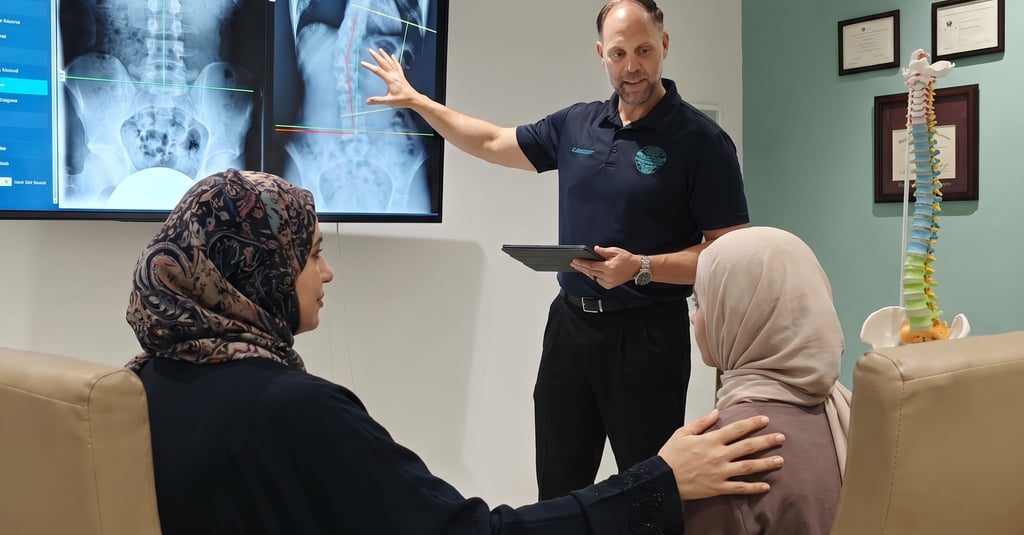
Scoliosis is a three-dimensional structural deformity of the spine, characterised by a sideways curvature combined with rotation of the vertebrae. To qualify as scoliosis, the curve must measure 10 degrees or more on an X-ray, using a measurement called the Cobb angle.
Unlike poor posture, scoliosis is not something a child can simply correct by "standing up straight." It is a structural condition that requires precise assessment and targeted treatment.
Types of Scoliosis
Idiopathic scoliosis — the most common type (around 80% of cases), with no known cause. It typically develops during adolescent growth spurts.
Congenital scoliosis — present at birth, caused by vertebral malformations.
Neuromuscular scoliosis — associated with conditions like cerebral palsy or muscular dystrophy.
Degenerative (adult) scoliosis — develops in adulthood, often due to age-related disc and joint degeneration.
Early Warning Signs Every Parent Should Know
Scoliosis often progresses silently. Most curves don't cause pain in the early stages, which is why visible postural changes are typically the first clue. Look for:
One shoulder higher than the other
Uneven hips or waistline
One shoulder blade more prominent than the other
Body leaning visibly to one side
Clothes that don't hang evenly
Persistent back fatigue, stiffness, or one-sided discomfort
Asymmetry of the rib cage when the child bends forward (Adam's Forward Bend Test)
If you notice any of these signs, a professional scoliosis assessment is the next step. Early detection dramatically expands the range of non-surgical treatment options available.
Scoliosis FAQ: Your Most Common Questions, Answered
1. At what age does scoliosis usually develop?
Adolescent idiopathic scoliosis — the most common form — typically appears between ages 10 and 15, during periods of rapid growth. However, scoliosis can develop earlier (juvenile or infantile) or much later (adult degenerative scoliosis). This is why screening matters at every stage of life.
2. Will my child need surgery?
In most cases, no — particularly when scoliosis is detected early. Modern scoliosis care follows a clear treatment hierarchy:
Observation for very mild curves (under 20°)
Bracing combined with structural rehabilitation for curves between 20° and 40°
Surgery is typically only considered when curves exceed 45°–50° and continue to progress
With early intervention using ScoliBrace® and Chiropractic BioPhysics® rehabilitation, many families avoid surgery altogether.
3. Is scoliosis painful?
Children and adolescents with scoliosis often experience no pain at all in the early stages. Adults with scoliosis, however, frequently develop chronic back pain, sciatica, and postural fatigue — often years or decades after the curve first formed. Pain is not a reliable indicator of scoliosis severity.
4. Can adults be treated for scoliosis?
Absolutely. Adult scoliosis responds well to non-surgical care, particularly for pain relief, postural correction, and slowing curve progression. While adult curves are typically less flexible than adolescent curves, the combination of CBP® rehabilitation and adult-specific bracing can produce meaningful improvements in quality of life.
5. What causes scoliosis?
Most cases (idiopathic) have no clear single cause, though genetic predisposition plays a role. Scoliosis is not caused by carrying heavy backpacks, poor posture, or sports participation — although these factors can exacerbate symptoms in someone who already has a curve.
6. How is scoliosis diagnosed?
Diagnosis combines a thorough physical assessment, digital postural analysis, and full-spine radiographic imaging. The defining measurement is the Cobb angle, taken from an X-ray, which determines both the severity of the curve and the appropriate treatment pathway.
7. Will exercise alone correct scoliosis?
Exercise alone — including yoga, Pilates, or generic physiotherapy — cannot structurally correct a scoliotic curve. While targeted, scoliosis-specific exercises (such as the Schroth method or CBP® mirror-image rehabilitation) play an important supporting role, they work best when combined with appropriate bracing for moderate curves.
8. How long does scoliosis treatment take?
Treatment duration depends on the patient's age, curve severity, skeletal maturity, and treatment goals. Bracing is typically worn through the remainder of skeletal growth (often 18–36 months for adolescents), with rehabilitation continuing alongside. Adult treatment is more open-ended and tailored to functional goals.
ScoliBrace®: The Next Generation of Scoliosis Bracing
For decades, the standard of scoliosis bracing was the Boston Brace — a rigid, compression-based design intended primarily to stop curves from worsening. While effective at preventing progression, traditional braces rarely reduced existing curves and were notoriously uncomfortable, contributing to poor patient compliance.
ScoliBrace® represents a fundamentally different approach.
What Makes ScoliBrace® Different?
Custom-designed using 3D body scanning. Each ScoliBrace® is individually designed using a full 3D scan of the patient's body, combined with their specific X-ray measurements. There is no "off-the-shelf" version — every brace is unique to the patient's curve pattern.
Over-correction principle. Unlike compression-based braces that simply push against the curve, ScoliBrace® uses an over-correction approach: the brace places the body into a mirror-image posture of the existing curve. This actively encourages structural curve reduction, not just stabilisation.
Improved comfort and wearability. ScoliBrace® uses a lower-profile design with strategic openings and breathable materials, making it more comfortable and discreet under clothing. Better comfort means better compliance — and compliance is the single biggest predictor of bracing success.
Designed for combined care. ScoliBrace® is built to integrate with structural rehabilitation protocols like Chiropractic BioPhysics® (CBP®), creating a synergistic treatment effect that bracing or rehabilitation alone cannot match.
Who Is ScoliBrace® Suitable For?
Adolescents with idiopathic scoliosis (curves of 20°–40°)
Children with juvenile or early-onset scoliosis
Adults with progressive scoliosis seeking non-surgical management
Patients with kyphosis (hunchback) — using the related KyphoBrace®
Patients who have not responded to traditional bracing
The ScoliBrace® Process at CBP Precision Spine Center
Step 1 — Comprehensive Assessment. Full clinical examination, digital postural analysis, and full-spine X-rays to measure your exact Cobb angle and curve pattern.
Step 2 — 3D Body Scan. We capture a detailed 3D scan of your body, which is combined with your X-ray data and sent to the ScoliBrace® design team.
Step 3 — Custom Brace Manufacture. Your individualised brace is manufactured and shipped to our clinic in Muscat.
Step 4 — Fitting and Education. We professionally fit the brace, demonstrate how to wear and maintain it, and create a wearing schedule tailored to your case.
Step 5 — Combined Rehabilitation. Your bracing is paired with Chiropractic BioPhysics® mirror-image exercises and structural adjustments — the combination that drives measurable curve reduction.
Step 6 — Ongoing Monitoring. Regular follow-ups, repeat imaging at appropriate intervals, and brace adjustments as the curve responds to treatment.
Why CBP® + ScoliBrace® Works Better Than Bracing Alone
Chiropractic BioPhysics® is the only chiropractic technique with treatment protocols backed by over 366 peer-reviewed scientific studies. It uses precise measurement, mirror-image postural exercises, specific spinal adjustments, and structural traction to actively reduce spinal misalignments — including scoliotic curves.
When combined with ScoliBrace®, the two treatments reinforce one another:
ScoliBrace® holds the corrected position during daily activities
CBP® rehabilitation builds the muscular and structural support to maintain that correction
Together, they produce measurable Cobb angle reduction — not just stabilisation
Dr. Richard Marchetti, DC is the only Advanced Certified CBP® practitioner in the Middle East, and one of just 98 worldwide. This level of certification is what makes the combined CBP® + ScoliBrace® protocol available at our clinic in Muscat.
When Should You Book a Scoliosis Assessment?
Book a professional scoliosis assessment if:
Your child has any of the visible warning signs listed earlier
There is a family history of scoliosis
Your child is between ages 10–15 and has never been screened
You have been diagnosed with scoliosis as an adult and have been told "there is nothing that can be done"
You are currently using a traditional brace but want to explore a more effective option
You are considering surgery and want a second opinion on non-surgical alternatives
Early assessment doesn't commit you to treatment — it simply gives you accurate information about your spine and the options available.
Book Your Scoliosis Assessment in Muscat
CBP Precision Spine Center is the leading non-surgical scoliosis care provider in Oman, combining international-grade ScoliBrace® bracing with Advanced CBP® structural rehabilitation.
📍 Villa 336, 18 November Street, Azaiba, Muscat
🕐 Sunday – Thursday | Multilingual team
📞 +968 9648 7937
🌐 cbpsj.com
Book your scoliosis consultation today and take the first measurable step toward a stronger, healthier spine.
CBP Precision Spine Center
Villa 336, 18th November St
Azaiba, Muscat
Oman, 130
Quick Links
Subscribe To Our News Letter!
info@CBPSJ.com
+968 7277 7796
© 2024. All rights reserved.